Four hundred years before mechanical clocks ticked in European towers, a city on the Fujian coast was already arguing about what an hour meant.
The argument went like this: time can be measured — by water, by shadow, by the slow wheel of stars — but it can also be kept. And a city that keeps time differently begins to keep memory differently, too.
The Tower That Named the Hours
In 1092, the statesman Su Song completed the Shui Yun Yi Xiang Tai — the Water-Powered Armillary Sphere and Celestial Globe Tower — in Kaifeng. It stood perhaps twelve meters tall. Water, measured in scoops, drove an escapement wheel; the wheel turned an armillary sphere on the roof, a celestial globe in an upper chamber, and a carousel of jacks below, each emerging with a placard to announce the hour.
It was a clock the size of a building. But more than that, it was a claim: that the order of the heavens could be brought down into the order of a city, and that a city’s hours could be honest.
What the Coast Learned
The tower was dismantled within decades — invaded, scattered, rebuilt in fragments. What survived was not the machine but the habit: the insistence that a moment worth marking deserves a mechanism worth trusting.
We think Story & Hour exists in that habit. A birthday is a date; the sky above it is a map. An anniversary is a number; the years inside it are a story. The objects we design are small towers of the same idea — time, kept.
To Hold an Hour
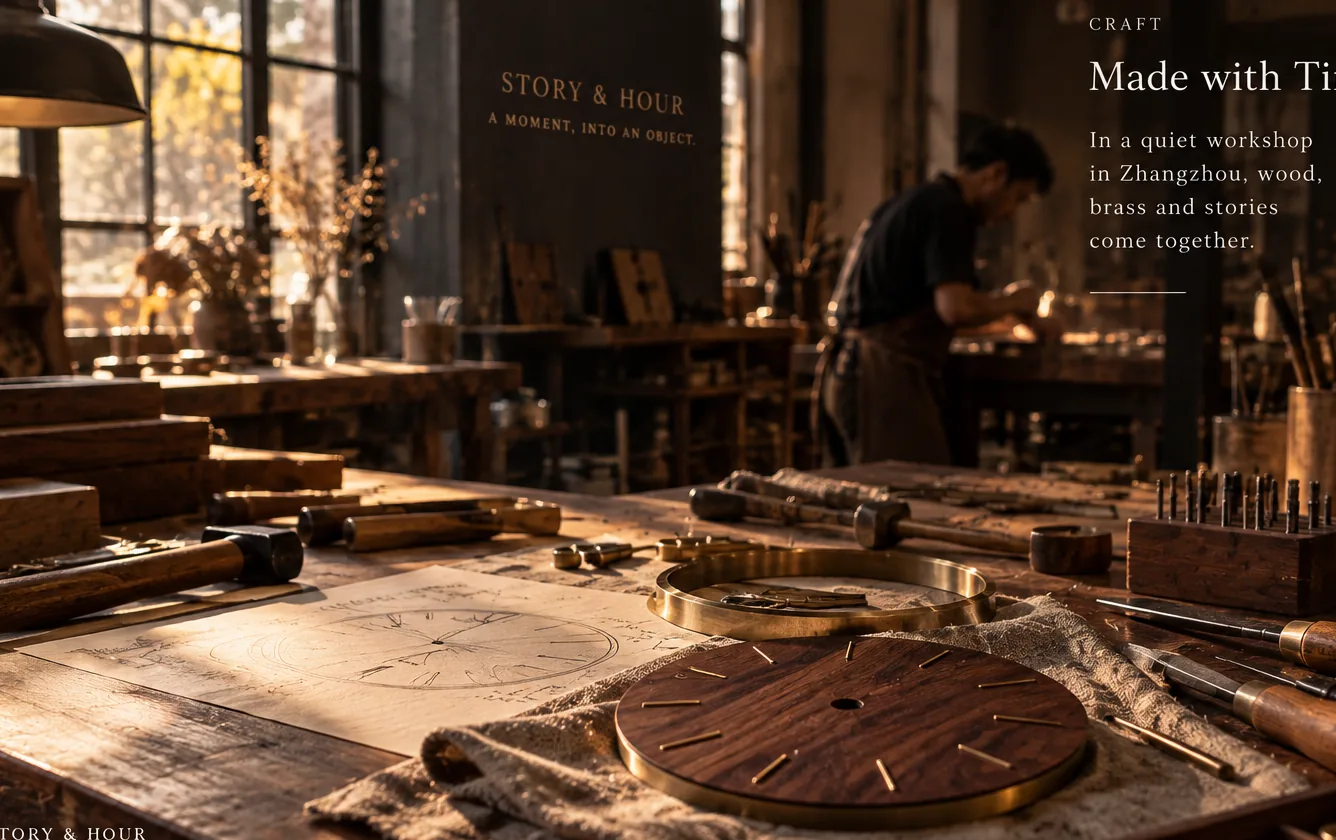
When we build a dial from the star positions of a particular night, we are not decorating. We are doing what Su Song’s engineers did: giving a moment a mechanism, so it can be revisited honestly, decades later, by someone who was there.
The archive keeps the essay; the object keeps the hour.