Time — A Story & Hour Cultural Series, No. 4
Kaifeng, the winter of 1092. In the great capital of the Northern Song, snow lies on the rooftiles of a million homes, and an old drum-keeper named Wu shuffles across the courtyard of the Bureau of Astronomy, breathing on his hands. His job is ancient: to mark the watches, beat by beat, until dawn. He carries his incense, as he has for thirty years.
Then, above him, the tower strikes.
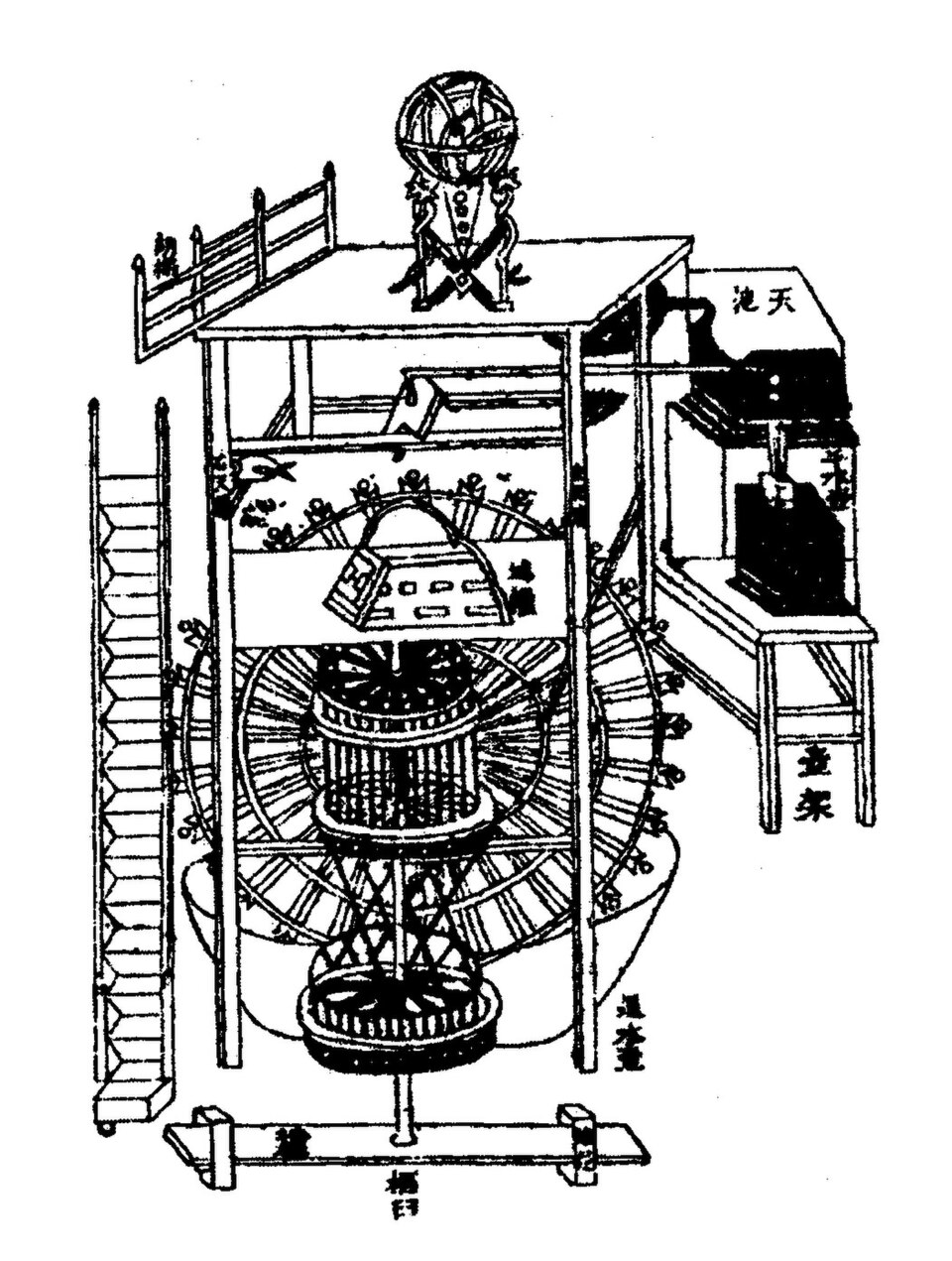
Not a man. A machine. Somewhere inside a wooden tower nearly twelve meters tall — the water-powered astronomical clock tower (水运仪象台, shuiyun yixiangtai) designed by Su Song (苏颂, 1020–1101) — a small wooden figure has just slid forward on its pivot and rung a bronze bell for the third watch, unprompted, in the dark. Below the bell-tier, four more tiers of jacks wait their turns with placards and drums. On the open roof, a bronze armillary sphere turns so slowly it seems still, tracking the real sky wheel for wheel. And the whole apparatus — hours, stars, tiny heralds — is driven by nothing but water, falling in silence, scoop by measured scoop, through the tower’s hidden heart.
Wu the drum-keeper stands in the snow and listens until the bell’s hum dies. For the first time in his life, the night knows its own depth without him. His incense is still burning in his sleeve. He does not need it now.
Inside that tower stood one of the most sophisticated machines the world would see for the next five hundred years. This is the story of who built it, how a drip of water was taught to keep time like a heartbeat — and why the world forgot it, then remembered.
The Question the Tower Asked
A clock tells you the hour. But Su Song’s machine did something stranger: it ran the sky — the stars outside had a bronze twin inside, rising when they rose, setting when they set, night after night.
Which raises the question the tower seems to have been asking all along. Can a moment — a night, a season, a position of the stars — be held by a machine, the way a jar holds water? And if it can, what exactly are we holding?
Chapter I — The Scholar Who Was Asked to Build the Sky
In 1086, the Song court asked Su Song to build a new armillary sphere — the ring-mounted bronze instrument astronomers used to measure the positions of stars. It was a reasonable request. Su Song was sixty-six, a scholar-diplomat of enormous reputation: envoy, pharmacologist, veteran of the astronomy bureau. What the court expected was an instrument. What it got was a universe.
The turning point was a personnel decision. Among the bureau’s junior officials was a mathematician named Han Gonglian (韩公廉), so skilled in calculation that colleagues spoke of him as something between a craftsman and a wizard. Su Song knew the lineage of Chinese water-driven timekeepers: the monk Yi Xing (一行) had built an escapement-driven celestial machine as early as 725, and in 979 Zhang Sixun (张思训) had built a tower clock driven by falling mercury, which would not freeze in winter. Su Song asked Han Gonglian to take the idea further than anyone had.
Han returned with a demonstration: a wooden model in which falling water turned a great wheel — and the wheel, turning, moved the heavens. The motions of sun, moon, and stars, Su Song wrote, could be gathered into one continuous machine, so that “the instrument and the sky agree.” A model was tested before the emperor in 1088. The full tower, in bronze and timber, was completed in 1092.
Picture Su Song in those years — by day a state councilor, by night walking the scaffolded tower as Han Gonglian’s crews fitted the wheel. He was past seventy when it was done. He knew he would not see how long it lasted.
Chapter II — The Drip and the Balance: How Su Song’s Clock Tamed Time
Every water clock faces the same enemy: water itself. As a tank empties, the pressure drops and the “hours” stretch and shrink. The ancients could tell time by dripping water; what they could not do was make the dripping honest.
Su Song’s team solved it with a ladder of settling tanks, each feeding the next, so that the final tank stayed at a nearly constant level — and the water left it at a nearly constant rate. Drop. Drop. Drop.
The masterstroke came next. The water fell into scoops set around the rim of a great vertical wheel — thirty-six of them. A single scoop could not turn the wheel; it was held in place by an ingenious linkage of levers, weights, and lock-arms that Su Song’s team called the celestial balance (天衡, tianheng). Only when a scoop had filled completely did its weight tip the balance, release the lock, and let the wheel turn — by exactly one scoop’s width. Then it stopped. Held. Waited.
Tick. The wheel advanced one step. Water filled the next scoop. Tick.
This mechanism — rhythmic check-and-release, check-and-release — is an escapement, and it is the heart of mechanical horology. It converts a continuous push into equal, countable beats: the “tick-tock” of a clock is nothing but an escapement arguing politely with a power source. In Europe, the verge escapement would not drive its first tower clocks until the end of the thirteenth century. Joseph Needham, the Cambridge historian of Chinese science, argued that this Chinese lineage — Yi Xing, Zhang Sixun, Su Song — had been running escapement-driven clocks for centuries before that. Two centuries before Europe, in Su Song’s case; six, counting from Yi Xing.
Look at a mechanical wristwatch, if you still own one. Inside, a balance wheel swings and a pallet fork catches and releases a gear, hundreds of thousands of times a day. It is Han Gonglian’s problem, solved with Han Gonglian’s logic, miniaturized onto a wrist. Every tick is a descendant of that drip.
Chapter III — A Universe in Bronze, and an Ending in Fire
What made the tower unlike any machine on Earth was that it was three machines in one — an observatory, a clock, and a working model of the cosmos, stacked in a single wooden body.
On the open platform at the top sat the armillary sphere (浑仪, hunyi), its nested bronze rings aligned to the celestial poles — the instrument Chinese astronomers had long used to measure where the stars stood. But Su Song’s armillary was not passive: gears from the central drive rotated it beneath the sky. It watched, as it were, on its own.
Below it, in a closed chamber shrouded like a planetarium, hung the celestial globe (浑象, hunxiang) — a great bronze sphere painted with the star patterns of the Chinese sky: the 28 lunar mansions, the enclosures of the Purple Court, the Milky Way. The same waterwheel that rang the bells turned this sphere at the sky’s own pace. When the real Antares rose over Kaifeng’s walls, its bronze twin rose inside the tower. A scholar in that lamplit chamber could watch the entire heavens pass, clouds or no clouds.
And beneath the globe, five tiers of jacks — wooden heralds who emerged through opened doors to strike bells, beat drums, and display placards naming the double-hour and the night watch, in an age when most of the world told time by shadow and church bell.
It ran for over thirty years. Then the world broke.
In 1127, the armies of the Jin swept down on Kaifeng. The city fell; the Northern Song collapsed into its southern remnant. The tower — too precious to burn, too complex to move — was dismantled, crated, and shipped north to the Jin capital near modern Beijing. There it was reassembled — and there, by nearly all accounts, it never truly ran again. The craftsmen who understood its heart had scattered or died in the war. Without them, the universe in bronze went silent.
What survived was a book. Su Song, in his seventies, had done something builders of wonderful machines almost never do: he wrote everything down. His treatise, Xin Yi Xiang Fa Yao (新仪象法要, New Design for an Armillary Sphere and Celestial Globe, 1096), preserved the tower in dozens of mechanical drawings — waterwheel, tanks, celestial balance, jackwork — along with star maps among the oldest printed charts in existence. For eight hundred years the tower existed mostly as ink on paper: a sleeping machine, waiting.
The waking took centuries. In the mid-twentieth century, Joseph Needham and his collaborators in Science and Civilisation in China pulled Su Song’s clock into the world history of horology. Working reconstructions have since been built in Kaifeng, where the tower once stood; in Su Song’s southern hometown; and in the National Museum of Natural Science in Taichung, Taiwan, where a version built from the old treatise alone still turns its wheel, scoop by scoop, as it did on winter nights in 1092.
It was forgotten by the accident of war. It was remembered by the accident of a book — and by the stubbornness of an old man who believed a machine deserves a witness.
Watching Your Own Sky Tonight
Here is the strange gift the tower leaves us. The machine is gone; the question it asked is not. Every clock you have ever trusted descends from the same problem Han Gonglian solved: how to make a flow honest, how to divide the unbroken river of time into drops you can count and keep.
And the tower suggests a second, quieter question. The Chinese measured hours by burning incense and by falling water not because they worshipped precision, but because they believed a moment deserves a keeper. A night watch deserves a bell. A sky deserves a bronze twin. A life deserves its coordinates, noted down.
Look at the sky tonight. On a clear evening you can see the same stars that rose over Kaifeng in 1092; nine centuries of machines have counted the hours beneath them. You are watching from inside your own moment, the way Wu the drum-keeper watched the tower ring the third watch and felt, perhaps for the first time, both replaced and freed.
A Moment to Keep
Su Song’s tower understood something we are still relearning: time cannot be stopped, but it can be kept — caught drop by drop, given a bell, a face, a turning sphere, a name. That is why the ancients built machines at all: not to cheat time, but to honor it. At Story & Hour, we make objects that do the same for the small instants of a life — the night, the season, the one clear sky — so that what falls silently can still be carried forward, and made to ring.
Frequently Asked Questions
What was Su Song’s water-powered astronomical clock tower? The 水运仪象台 (shuiyun yixiangtai) was a roughly 12-meter wooden tower completed in 1092 in Kaifeng, capital of the Northern Song. Designed by Su Song with the mathematician Han Gonglian, it combined an observatory, a striking clock, and a rotating model of the cosmos — all driven by falling water.
How did the escapement mechanism in Su Song’s clock work? Water dripped at a constant rate from settling tanks into 36 scoops on a great vertical wheel. A lever-and-lock system called the “celestial balance” (tianheng) held the wheel still until a scoop filled, then released it exactly one scoop’s width — turning a steady flow into equal, countable ticks, the principle of every later mechanical clock.
Why is Su Song’s clock considered ahead of Europe? Its escapement was mature in China by 1092, roughly two centuries before the verge escapement drove Europe’s first tower clocks, and Chinese escapement clocks date back to Yi Xing’s machine of 725 — a lineage Joseph Needham brought to wide attention in Science and Civilisation in China.
What happened to the original tower? It was dismantled after the Jin conquest of Kaifeng in 1127 and reassembled in the north, but without its master craftsmen it never ran reliably again and was eventually lost. Su Song’s 1096 treatise Xin Yi Xiang Fa Yao preserved the design in drawings and star maps, enabling modern reconstructions.
Can you still see a reconstruction of the Su Song clock today? Yes. Working reconstructions based on the surviving treatise stand in Kaifeng (where the original tower stood), in Su Song’s hometown region, and in the National Museum of Natural Science in Taichung, Taiwan.
Explore more from the Time universe → /time/time-universe-pillar